Development of Functional ADAPTEX Prototypes
Downloads
DOI:
https://doi.org/10.7480/jfde.2021.1.5539Published
Issue
Section
License
Copyright (c) 2021 Paul-Rouven Denz, Christiane Sauer, Ebba Fransén Waldhör, Maxie Schneider, Puttakhun Vongsingha

This work is licensed under a Creative Commons Attribution 4.0 International License.
Authors or their institutions retain copyright to their publications without restrictions.
How to Cite
Keywords:
adaptive sun-shading, textile building envelope, smart materials, autarkic operation and control mechanism, Shape Memory Alloy (SMA)Abstract
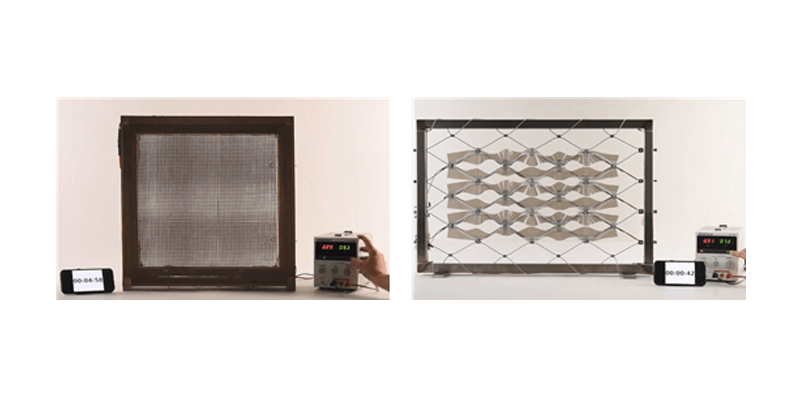
The research project ADAPTEX pursues the goal of developing adaptive, energy-efficient textile sun shading systems using the smart material Shape Memory Alloy (SMA). Within this approach lies a high potential for novel sun protection systems demanding little energy or even self-sufficiently adapting to external stimuli while reducing operation and maintenance costs and at the same time offering solutions to tackle growing demand for sun and glare protection. A Design Categories Matrix is presented that brings together various involved fields from textile design and façade construction to smart material development. Based on this, two concepts have been further elaborated: ADAPTEX Wave and Mesh. Both incorporate SMA into textile structures but express different design and performance potential by changing the geometry and openness factor of the surface area. For further evaluation, various functional prototypes that scale up from 0.2 x 0.2 m to 1.35 x 2.80 m are developed and reviewed. The buildability and functionality of SMA-driven textile sun shading systems that incorporate requirements from the various involved fields are verified. The feasibility of parallel ADAPTEX Wave
and Mesh were assessed in comparison to the performance of state-of-the-art sun shading systems. The technological ideas are subsequently optimised and scaled up in various cycles for follow-up testing in both indoor and outdoor environments.
References
Addington, D. M., & Schodek, D. L. (2005). Smart materials and new technologies : for the architecture and design professions. Oxford, USA: Architectural Press.
Aelenei, L., Aelenei, D., Romano, R., Mazzucchelli, E. S., Brzezicki, M., & Rico-Martinez, J. M. (2018). Case Studies - Adaptive Facade Network. TU Delft Open.
Amidror, I. (2009). The Theory of the Moiré Phenomenon. London: Springer-Verlag. doi:10.1007/978-1-84882-181-1
Barozzi, M., Lienhard, J., Zanelli, A., & Monticelli, C. (2016). The Sustainability of Adaptive Envelopes: Developments of Kinetic Architecture. Procedia Engineering (155), 275-284. doi:10.1016/j.proeng.2016.08.029
Begle, M. (2013, June 9). Advanced Materials – Shape Memory Alloy – Nitinol. Retrieved from http://www.iaacblog.com/programs/ advanced-materials-shape-memory-alloy/
Böke, J., Knaack, U., & Hemmerling, M. (2018, March 26). State-of-the-art of intelligent building envelopes in the context of intelligent technical systems. Intelligent Buildings International. doi:10.1080/17508975.2018.1447437
Braun, D. H. (2008). Bionisch inspirierte Gebäudehüllen. Konzeption einer bionisch inspirierten Gebäudehülle nach dem Vorbild natürlicher Hüllen und Häute (Bionically inspired building envelopes. Conception of a bionically inspired building envelope based on the model of natural envelopes and skins). Stuttgart: Universität Stuttgart.
Callejas Ortega, M. A. (2015). Análisis y estudio metodológico de las aplicaciones de los materiales con memoria de forma y superelasticidad en arquitectura y urbanismo (Analysis and methodological study of the applications of materials with shape memory and superelasticity in architecture and urbanism). Seville: Escuela Técnica Superior de Arquitectura, Universidad de Sevilla.
Carl Stahl ARC GmbH. (2019). X-LED. Retrieved from https://x-led.de/en/
Cherif, C. (2017). Entwicklung von Textilstrukturen mit textiltechnisch integrierten Formgedächtnislegierdrähten zur Umsetzung komplexer Verformungen in Faserkunststoffverbundanwendungen (Development of textile structures with textile-technically
integrated shape memory alloy wires for the implementation of complex deformations in fiber plastic composite applications). Retrieved from https://forschungsinfo.tu-dresden.de/detail/forschungsprojekt/16051
Cilento, K. (2012). Al Bahar Towers Responsive Facade / Aedas. Retrieved from archdaily: https://www.archdaily.com/270592/ al-bahar-towers-responsive-facade-aedas
Denz, P. R. (2015, September 22). Intelligente Gebäudehüllen und Smart Textiles - eine ideale Kombination (Intelligent building envelopes and smart textiles - an ideal combination). Retrieved from https://smarttex-netzwerk.de/en/events/199-workshopon-22-09-2015
Denz, P. R. (2017). Textile Building Skin. New Functionality due to Smart Textiles. In U. Knaack, & U. Pottgiesser (Eds.)., efnMOBILE 2.0 : Efficient Envelopes (pp. 94-109). Delft: TU Delft Open. Retrieved from https://facades.ning.com/profiles/blogs/ efnmobile-workshop-textile-building-skin
Denz, P.-R., Sauer, C., Boxberger, L., Waldhör, E. F., Schneider, M., & Vongsingha, P. (2018). ADAPTEX. smart³ Tage. Berlin.
Denz, P.-R., Sauer, C., Waldhör, E. F., Schneider, M., & Vongsingha, P. (2020). Smart Textile Sun Shading. 15th Conference on Advanced Building Skins. Bern.
Dewider, K., Mohamed, N., & Ashour, Y. (2013). Living Skins: A New Concept of Self Active Building Envelope Regulating Systems. SB13 Conference. Dubai.
European Comission. (2014). Technology readiness levels. Retrieved from https://ec.europa.eu/research/participants/data/ref/ h2020/wp/2014_2015/annexes/h2020-wp1415-annex-g-trl_en.pdf
Fiorito, F., Sauchelli, M., Arroyo, D., Pesenti, M., Imperadori, M., Masera, G., & Ranzi, G. (2016). Shape Morphing Solar Shadings: a Review. Renewable and Sustainable Energy Reviews(55), pp. 863-884. doi:10.1016/j.rser.2015.10.086
Habu, T. (2011). Applications of shape memory alloys (SMAs) in electrical appliances. In Shape Memory and Superelastic Alloys (pp. 87-99). Cambridge: Woodhead Publishing.
Josephine, S., Ruth, D., & Rebekah, S. D. (2020). Shape Memory Alloys. In Inamuddin, R. Boddula, M. I. Ahamed, & A. M. Asiri (Eds.). Alloy Materials and Their Allied Applications, pp. 213-223. Beverly, MA: Scrivener Publishing LLC. doi:10.1002/9781119654919. ch11
Khoo, C. K., Salim, F., & Burry, J. (2011). Designing Architectural Morphing Skins with Elastic Modular Systems. International Journal of Architectural Computing, 4(9).
Kuhn, T. E. (2017). State of the art of advanced solar control devices for buildings. Solar Energy. Advance online publication. https://doi.org/10.1016/j.solener.2016.12.044
Lieleveld, C. (2013). Smart Materials for the Realization of an Adaptive Building Component. Delft: TU Delft.
Loonen, R. C., Trčka, M., Cóstola, D., & Hensen, J. L. (2013). Climate adaptive building shells: State-of-the-art and future challenges. Renewable and Sustainable Energy Reviews, 25, 483-493. doi:10.106/j.rser.2013.04.16
Neugebauer, R., Drossel, W.-G., Pagel, K., Bucht, A., & Zernecke, A. (2011). Design of a controllable shape-memory-actuator with mechanical lock function. Active and Passive Smart Structures and Integrated Systems, 11.
Ritter, A. (2007). Smart materials in architecture, interior architecture and design. Basel; Berlin et al.: Birkhäuser.
Sauer, C., Waldhör, E. F., Schneider, M., Denz, P.-R., Vongsingha, P., Miodragovic, N., & Brucks, M. (2018). Shaping Shades. Retrieved from weißensee kunsthochschule berlin: https://kh-berlin.de/projekt-detail/Project/detail/shaping-shades-2830.html
Schneider, M., Waldhör, E. F., Denz, P.-R., Vongsingha, P., Suwannapruk, N., & Sauer, C. (2020). Adaptive textile façades through the integration of Shape Memory Alloy. ACADIA 2020 Conference Proceedings.
Sigmund, B. (2016). Solar Curtain – Sonnenschutz durch Formgedächtniseffekt (Solar Curtain - sun shading through shape memory effect). DETAIL Research. Retrieved from https://www.detail.de/artikel/solar-curtain-sonnenschutz-durch-formgedaechtniseffekt-28272/
smart³ e.V. (2017). Smart Skin : Selbstregulierende Sonnenschutzkomponenten für die Gebäudehülle (Smart Skin: Self-regulating sun protection components for the building envelope). Retrieved from http://www.smarthoch3.de/projekte/
United Nations General Assembly. (2015). Transforming our World: The 2030 Agenda for Sustainable Development. United Nations.
Wærsted, E. H. (2014). Textiles in the Material Practice of Architects - Opportunities, Challenges and Ways of Simulating Use. Lyngby: Technical University of Denmark.
Waldon, S., & Dyer, C. R. (1993). Dynamic Shading, Motion Parallax and Qualitative Shape. Proceedings IEEE Workshop on Qualitative
Vision, pp. 61-70. doi:10.1109/WQV.1993.262949


