Downloads
DOI:
https://doi.org/10.7480/jfde.2021.1.5442Published
Issue
Section
License
Copyright (c) 2021 Assoc. Prof. Mohannad Bayoumi

This work is licensed under a Creative Commons Attribution 4.0 International License.
Authors or their institutions retain copyright to their publications without restrictions.
How to Cite
Keywords:
Photovoltaic/thermal systems, radiant cooling, building-integrated photovoltaic, façade, solar coolingAbstract
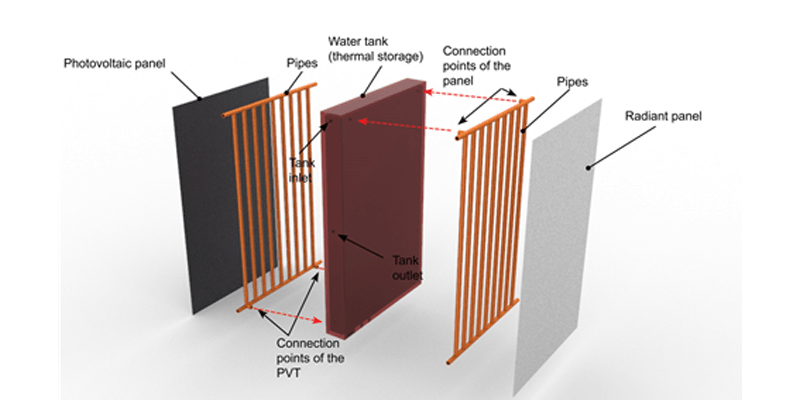
Hybrid photovoltaic/thermal (PVT) systems combine electric and thermal energy generation and provide noiseless operation and space-saving features. As the efficiency of photovoltaic (PV) panels increases at low surface temperatures, this paper suggests combining the PVT panel with a radiant cooling and heating panel in one system. A thermal storage tank fluidly connects the heat-exchanging pipes at the back of the PVT system and radiant panel. The upper portion of the tank feeds the radiant panel and the lower portion of the tank is connected to the PVT system. The proposed device is expected to function in connection with a heat pump that feeds the thermal storage. Using the dynamic thermal simulation software Polysun, the performance of the proposed façade-integrated device was investigated while considering the surface temperatures and energy production in the moderate climatic condition of the city of Munich. The results indicate a substantial impact on the efficiency of the PV module with an increase of up to 35% in the electricity production of the PV due to the lowered surface temperature. The obtained results contribute to façade-supported cooling/heating and electricity generation through the novel coupling and integration of PV, PVT, and radiant cooling elements.
References
Aste, N., Del Pero, C., & Leonforte, F. (2012). Optimization of solar thermal fraction in PVT systems. Energy Procedia, 30, 8–18. Retrieved from https://doi.org/10.1016/j.egypro.2012.11.003
Bayoumi, M. (2018a). Façade-integrated PVT with radiant cooling panels for increased energy and space efficiency. In 13th Conference on Advanced Building Skins (pp. 749–758). Bern: Advanced Building Skins GmbH.
Bayoumi, M. (2018b). Method to Integrate Radiant Cooling with Hybrid Ventilation to Improve Energy Efficiency and Avoid Condensation in Hot, Humid Environments. Buildings, 8(5), 69. Retrieved from https://doi.org/10.3390/buildings8050069
Bayoumi, M. (2020). Extending the Efficiency of Facade-Integrated PVT through Coupling with Radiant Cooling. Journal of Civil Engineering Inter Disciplinaries, 1(2), 5–16.
Henning, H.-M., & International Energy Agency. Solar Heating and Cooling Programme. (2004). Solar-assisted air-conditioning in buildings : a handbook for planners. Wien ; New York: Springer.
Hindrichs, D. U., & Daniels, K. (2007). Plusminus 20°/40° latitude : sustainable building design in tropical and subtropical regions. Stuttgart ; London: Edition A. Menges.
Hong, T., Yan, D., D’Oca, S., & Chen, C. (2017). Ten questions concerning occupant behavior in buildings: The big picture. Building and Environment, 114, 518–530. Retrieved 1 April 2017 from https://doi.org/10.1016/j.buildenv.2016.12.006
Huld, T., & Gracia Amillo, A. M. (2015). Estimating PV module performance over large geographical regions: The role of irradiance, air temperature, wind speed and solar spectrum. Energies, 8(6), 5159–5181. Retrieved from https://doi.org/10.3390/ en8065159
Natarajan, S. K., Mallick, T. K., Katz, M., & Weingaertner, S. (2011). Numerical investigations of solar cell temperature for photovoltaic concentrator system with and without passive cooling arrangements. International Journal of Thermal Sciences. Retrieved from https://doi.org/10.1016/j.ijthermalsci.2011.06.014
Pathak, M. J. M., Pearce, J. M., & Harrison, S. J. (2012). Effects on amorphous silicon photovoltaic performance from high-temperature annealing pulses in photovoltaic thermal hybrid devices. Solar Energy Materials and Solar Cells, 100, 199–203. Retrieved from https://doi.org/10.1016/j.solmat.2012.01.015
Prieto, A., Knaack, U., Auer, T., & Klein, T. (2017). SOLAR COOLFACADES Framework for the integration of solar cooling technologies in the building envelope. Energy. Retrieved from https://doi.org/10.1016/j.energy.2017.04.141
Pugsley, A., Zacharopoulos, A., Mondol, J. D., & Smyth, M. (2020). BIPV/T facades – A new opportunity for integrated collector-storage solar water heaters? Part 2: Physical realisation and laboratory testing. Solar Energy, 206(February), 751–769. Retrieved from https://doi.org/10.1016/j.solener.2020.05.098
pvoutput.org. (2020a). PVOutput-dahoam 4.176kW. Retrieved 18 November 2020, from https://pvoutput.org/display.jsp?sid=31109 pvoutput.org. (2020b). PVOutput-GB53 4.500kW. Retrieved 18 November 2020, from https://pvoutput.org/display.jsp?sid=75152
Razak, A., Irwan, Y., Leow, W. Z., Irwanto, M., Safwati, I., & Zhafarina, M. (2016). Investigation of the Effect Temperature on Photovoltaic (PV) Panel Output Performance. International Journal on Advanced Science, Engineering and Information Technology, 6(5), 682. Retrieved from https://doi.org/10.18517/ijaseit.6.5.938
Rhee, K.-N., & Kim, K. W. (2015). A 50 year review of basic and applied research in radiant heating and cooling systems for the built environment. Building and Environment, 91, 166–190. Retrieved 20 June 2017 from https://doi.org/10.1016/j. buildenv.2015.03.040
Seo, J.-M., Song, D., & Lee, K. H. (2014). Possibility of coupling outdoor air cooling and radiant floor cooling under hot and humid climate conditions. Energy and Buildings, 81, 219–226. Retrieved 11 July 2014 from https://doi.org/10.1016/j.
enbuild.2014.06.023
Song, D., & Kato, S. (2004). Radiational panel cooling system with continuous natural cross ventilation for hot and humid regions, 36, 1273–1280. Retrieved from https://doi.org/10.1016/j.enbuild.2003.07.004
Stetiu, C. (1999). Energy and peak power savings potential of radiant cooling systems in US commercial buildings. Energy and Buildings, 30(2), 127–138. Retrieved from https://doi.org/https://doi.org/10.1016/S0378-7788(98)00080-2
Vangtook, P., & Chirarattananon, S. (2007). Application of radiant cooling as a passive cooling option in hot humid climate. Building and Environment, 42(2), 543–556. Retrieved from https://doi.org/10.1016/j.buildenv.2005.09.014
Zhang, L. Z., & Niu, J. L. (2003). Indoor humidity behaviors associated with decoupled cooling in hot and humid climates. Building and Environment, 38(1), 99–107. Retrieved from https://doi.org/10.1016/S0360-1323(02)00018-5
Zhang, X., Zhao, X., Smith, S., Xu, J., & Yu, X. (2012). Review of R&D progress and practical application of the solar photovoltaic/ thermal (PV/T) technologies. Renewable and Sustainable Energy Reviews, 16(1), 599–617. Retrieved from https://doi. org/10.1016/j.rser.2011.08.026


