installation and validation

Downloads
DOI:
https://doi.org/10.47982/jfde.2025.333Published
Issue
Section
License
Copyright (c) 2026 David Ciro Sierra Garcia

This work is licensed under a Creative Commons Attribution 4.0 International License.
Authors or their institutions retain copyright to their publications without restrictions.
How to Cite
Keywords:
Façade, building envelopes, modular construction, Installation, Verification, AR (Augmented reality), WebXR, Building Information Modelling (OpenBIM), SPA (Single page application)Abstract
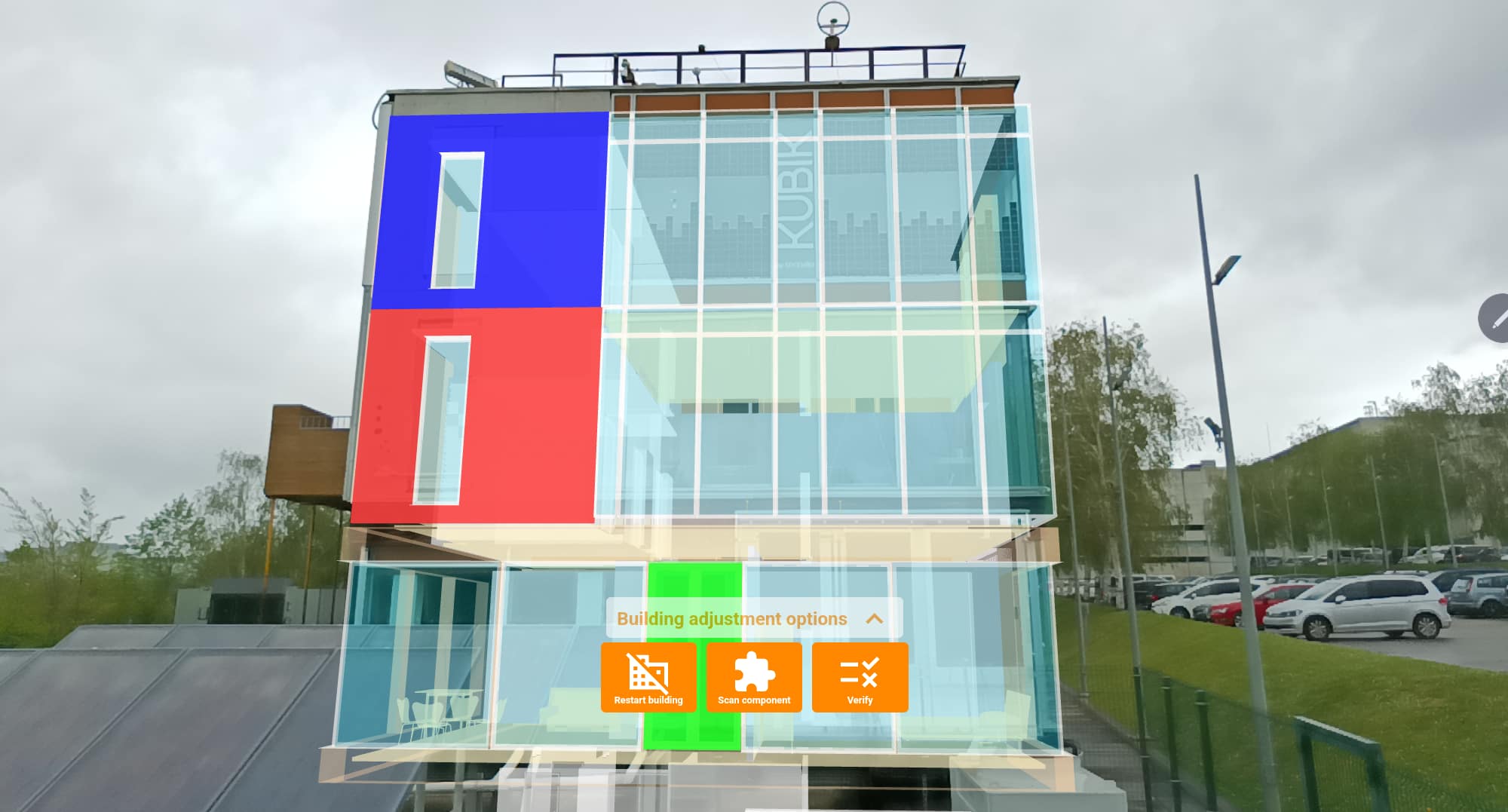
As part of a project aimed at upgrading older, non-renovated buildings by retrofitting their envelopes to meet the European climate targets required by 2050, a low-cost Augmented Reality (AR) tool was developed to facilitate the renovation and maintenance process. Considering that the renovation process involves a large number of different panels, which are assembled like a large puzzle in the building using plug-and-play techniques, traceability remains a challenge. To facilitate the assembly of the panels, which contain digital information, and using AR techniques, the panels will be displayed on the real building in their final position.
In this way, AR tools will bridge the gap between digital information and the real-world environment, allowing users to visualise information about the position to be installed in the real place. Additionally, the tool will have the option to display further information (such as safety instructions or installation details) related to each panel, ensuring that workers have all necessary information on-site. Developed as a web-based Single Page Application (SPA) compatible with standard smartphones and tablets via WebXR, the tool eliminates the need for expensive hardware or software installations.
The tool demonstrates the feasibility of using a cost-effective AR solution to provide necessary information to on-site operators, as well as generating real-time Key Performance Indicators (KPIs) and alerts that managers can consult.
References
long-term strategy. (n.d.). Retrieved March 17, 2025, from https://climate.ec.europa.eu/eu-action/climate-strategies-targets/2050-long-term-strategy_en
AEGIR EU Project. (2024, March 6). Project - AEGIR. Retrieved March 17, 2025, from https://aegirproject.eu/project/
Azhar, S. (2011). Building information modeling (BIM): Trends, benefits, risks, and challenges for the AEC industry. Leadership and Management in Engineering, 11(3), 241–252. https://doi.org/10.1061/(asce)lm.1943-5630.0000127 DOI: https://doi.org/10.1061/(ASCE)LM.1943-5630.0000127
Bressan, N. M., Scarpa, M., & Peron, F. (2024). Case studies of eXtended reality combined with building information modeling: A literature review. Journal of Building Engineering, 84, 108575. https://doi.org/10.1016/j.jobe.2024.108575 DOI: https://doi.org/10.1016/j.jobe.2024.108575
Callegaro, N., & Albatici, R. (2023). Energy retrofit with prefabricated timber-based façade modules: Pre and post comparison between two identical buildings. Journal of Facade Design and Engineering, 11(1), 001–018. https://doi.org/10.47982/jfde.2023.1.01 DOI: https://doi.org/10.47982/jfde.2023.1.01
Chai, C., Mustafa, K., Kuppusamy, S., Yusof, A., Lim, C. S., & Wai, S. H. (2019). BIM integration in augmented reality model. Civ. Eng, 10, 1266-1275. DOI: https://doi.org/10.14716/ijtech.v10i7.3278
Cordis, C. (2022, September 21). DigitAl and physical incrEmental renovation packaGes/systems enhancing envIronmental and energetic behaviour and use of Resources. Retrieved March 27, 2025, from https://cordis.europa.eu/project/id/101079961
Dallasega, P., Schulze, F., & Revolti, A. (2022). Augmented reality to overcome visual management implementation barriers in construction: A MEP case study. Construction Management and Economics, 41(3), 232–255. https://doi.org/10.1080/01446193.2022.2135748 DOI: https://doi.org/10.1080/01446193.2022.2135748
Edificio experimental KUBIK | Tecnalia. (n.d.). Retrieved March 17, 2025, from https://www.tecnalia.com/infraestructuras/edificio-experimental-kubik
Energy performance of buildings directive. (n.d.). Retrieved March 17, 2025, from https://energy.ec.europa.eu/topics/energy-efficiency/energy-efficient-buildings/energy-performance-buildings-directive_en
European Committee for Standardization. (2020). EN 17412-1:2020 – Building information modelling: Level of information need – Part 1: Concepts and principles. Retrieved from https://standards.cen.eu
European Parliament and Council. (2014). Directive 2014/24/EU on public procurement and repealing Directive 2004/18/EC. Official Journal of the European Union. Retrieved from https://eur-lex.europa.eu/legal-content/EN/TXT/?uri=CELEX:32014L0024
Gerger, A., Urban, H., & Schranz, C. (2023). Augmented reality for building authorities: A use case study in Austria. Buildings, 13(6), 1462. https://doi.org/10.3390/buildings13061462 DOI: https://doi.org/10.3390/buildings13061462
JavaScript with syntax for types. (n.d.). Retrieved June 20, 2025, from https://www.typescriptlang.org/
Immersive Web Developer. (n.d.). Retrieved March 17, 2025, from https://immersiveweb.dev/
International Organization for Standardization. (2018). ISO 19650-1:2018 – Organization and digitization of information about buildings and civil engineering works, including building information modelling (BIM) — Information management using building information modelling — Part 1: Concepts and principles. Retrieved from https://www.iso.org/standard/68078.html
Li, F., Laili, Y., Chen, X., Lou, Y., Wang, C., Yang, H., ... Han, H. (2023). Towards big data driven construction industry. Journal of Industrial Information Integration, 35, 100483. https://doi.org/10.1016/j.jii.2023.100483 DOI: https://doi.org/10.1016/j.jii.2023.100483
Li, J., & Wu, X. (2021). Safety management of prefabricated building construction based on BIM-RFID. In Advances in Intelligent Systems and Computing (pp. 1065–1071). https://doi.org/10.1007/978-981-16-1726-3_131 DOI: https://doi.org/10.1007/978-981-16-1726-3_131
Loebus, S., Ott, S., & Winter, S. (2014). The multifunctional TES-Façade joint. In Springer eBooks (pp. 31–43). https://doi.org/10.1007/978-94-007-7811-5_3 DOI: https://doi.org/10.1007/978-94-007-7811-5_3
Nassereddine, H., Hanna, A. S., Veeramani, D., & Lotfallah, W. (2022). Augmented reality in the construction industry: Use-cases, benefits, obstacles, and future trends. Frontiers in Built Environment, 8. https://doi.org/10.3389/fbuil.2022.730094 DOI: https://doi.org/10.3389/fbuil.2022.730094
Pannu, E. S., & Hooda, J. (2025). A comprehensive review on the integration of BIM in modular and prefabricated construction practices. International Journal of Research in Civil Engineering and Technology, 6(1), 101–106. https://doi.org/10.22271/27078264.2025.v6.i1b.85 DOI: https://doi.org/10.22271/27078264.2025.v6.i1b.85
Pan, N., & Isnaeni, N. (2024). Integration of augmented reality and building information modeling for enhanced construction inspection—A case study. Buildings, 14(3), 612. https://doi.org/10.3390/buildings14030612 DOI: https://doi.org/10.3390/buildings14030612
Pan, Y., Chen, J., Fu, Y., & Lu, W. (2023). Integrating smart construction objects and augmented reality for onsite assembly of modular construction. Computing in Construction. https://doi.org/10.35490/ec3.2023.178 DOI: https://doi.org/10.35490/EC3.2023.178
Pan, Y., & Zhang, L. (2022). Integrating BIM and AI for smart construction management: Current status and future directions. Archives of Computational Methods in Engineering, 30(2), 1081–1110. https://doi.org/10.1007/s11831-022-09830-8 DOI: https://doi.org/10.1007/s11831-022-09830-8
Rankohi, S., Rezvani, M., Waugh, L., & Lei, Z. (2023). Augmented reality application areas for the architecture, engineering, and construction industry. In IntechOpen eBooks. https://doi.org/10.5772/intechopen.1002723 DOI: https://doi.org/10.5772/intechopen.1002723
Sousa, J., Bragança, L., Almeida, M., & Silva, P. (2013). Application of prefabricated panels for the energy retrofit of Portuguese residential buildings façades: A case study. Archives of Civil Engineering, 59(3), 337–357. https://doi.org/10.2478/ace-2013-0019 DOI: https://doi.org/10.2478/ace-2013-0019
Strapi - Open source Node.js Headless CMS. (n.d.). Retrieved June 20, 2025, from https://strapi.io/
Three.js – JavaScript 3D library. (n.d.). Retrieved June 20, 2025, from https://threejs.org/
Vite. (n.d.). Retrieved June 20, 2025, from https://vite.dev/
WebXR Device API. (2024, October 21). Retrieved March 18, 2025, from https://www.w3.org/TR/webxr/
Xiao, Y., & Bhola, J. (2021). Design and optimization of prefabricated building system based on BIM technology. International Journal of Systems Assurance Engineering and Management, 13(S1), 111–120. https://doi.org/10.1007/s13198-021-01288-4 DOI: https://doi.org/10.1007/s13198-021-01288-4


